
OfficeSpace Defines New Workplace Software Category
OfficeSpace Software has launched a new enterprise technology category called Built World Operating Software, an AI-driven operating system designed to unify and optimize the planning, operation, and experience of physical workplaces by addressing the disconnect between workplace strategy and daily operations in hybrid and dynamic work environments.
January 21, 2026
OfficeSpace introduces Built World Operating Software
OfficeSpace Software defines new workplace software category, Built World Operating Software, with its AI Operating System for the Built World.
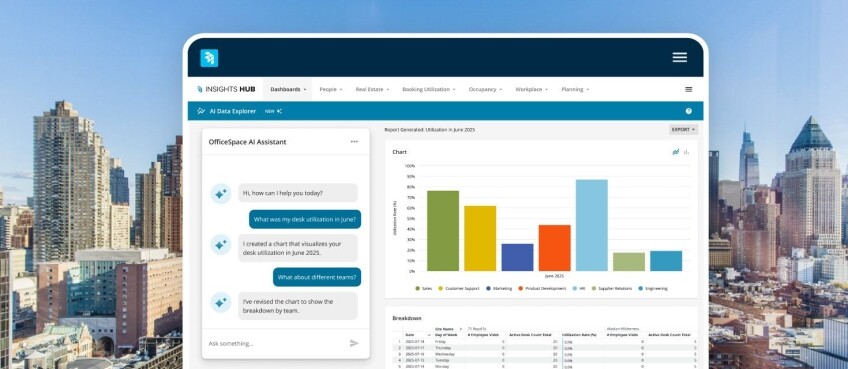
Atlanta, GA, January 21, 2026 — OfficeSpace Software defines new workplace software category, Built World Operating Software, with its AI Operating System for the Built World.
The built world—the buildings, spaces, and assets that power people, productivity, and performance—has always been foundational to how organizations operate. Today, that foundation is under renewed scrutiny. As organizations reinvest in their workplaces, CEOs and boards are demanding that every square foot deliver measurable value for both the business and the people inside it.
Built World Operating Software is a new category of enterprise technology designed to help the leaders responsible for the built world unify how organizations plan, operate, and experience their physical workplaces within a single intelligent system, rather than managing them through disconnected tools.
Most organizations manage their workplaces using static, siloed systems that were not designed for hybrid work, fluctuating attendance, sustainability goals, or real-time decision-making. As a result, leaders lack visibility into how workplace strategy translates into daily operations and employee experience, creating what OfficeSpace calls the Built World Experience Gap, the growing disconnect between workplace intent, performance, and human experience.
The consequences are both economic and human. Across underutilized space, asset downtime, and lost productivity, OfficeSpace estimates that organizations lose more than $1.3 trillion annually in the U.S. alone, while employees struggle with workplaces that fail to adapt to how they actually work.
“The built world directly shapes how people experience work—and how organizations perform,” said Erin Mulligan Helgren, CEO of OfficeSpace. “We continue to see extraordinary demand for our category-leading platform because workplace leaders need clear intelligence to understand what’s working, what’s not, and how workplace decisions affect both performance and people. We built the AI Operating System for the Built World to support smarter strategy while delivering better workplace experiences.”
A new category for a new workplace reality
For decades, workplace technology has been divided into two primary categories: Integrated Workplace Management Systems (IWMS) focused on operational execution, and Workplace Experience (WEX) platforms focused on employee-facing tools.
OfficeSpace was founded nearly 20 years ago to unify both, based on the belief that employee experience and operational strategy must inform one another, not exist in isolation.
By bringing workplace operations and experience together within a single intelligent platform, OfficeSpace gives leaders the visibility and control required to manage the built world strategically, while ensuring workplaces remain intuitive and responsive for the people who use them.
“OfficeSpace has always operated in its own category,” said Karen Bucks, Chief Marketing Officer at OfficeSpace Software. “Legacy workplace software was built as disconnected tools that promised integration but never delivered it. And while new startups are emerging, few can master the complexity of the built world or the depth of data required to truly support it—something we hear frequently from the clients who choose us. The future of work requires a unified, intelligent system that improves performance and makes the workplace more intuitive and human—and that’s the category we live in.”
The only AI operating system for the built world
The OfficeSpace platform combines AI-powered workplace operations, real estate and portfolio management, asset lifecycle management, and employee and visitor experience into a single system of record and action.
OfficeSpace also delivers a growing suite of AI agents and automated workflows that manage everyday workplace tasks—from forecasting space needs and anticipating maintenance to guiding employees to the resources they need—enabling leaders and teams to focus on higher-value, strategic work.
What further differentiates the platform is its proprietary AI model, purpose-built for the built world, trained on billions of anonymized data points derived from real workplace behavior across space usage, assets, maintenance, and employee interactions. This supports OfficeSpace’s agentic capabilities, and means generative scenarios and space recommendations are actionable and practical. Supported by an in-house team of AI and technology experts, the platform delivers enterprise-grade security, scale, and reliability—unlike solutions built on generic AI models.
Closing the built world experience gap
OfficeSpace is setting a new standard for how organizations plan, operate, and experience their workplaces, enabling clients to close the Built World Experience Gap by:
-
Increasing space utilization by up to 66%
-
Reducing real estate and operating costs by up to 30%
-
Extending asset lifespan by 10–20%
-
Improving employee productivity and engagement by up to 2.5x
For the first time, CEOs, CFOs, CIOs, CHROs, and workplace leaders can operate from a shared intelligence layer that connects space, assets, people, and performance—enabling decisions that benefit both the organization and the people who power it.
“The next era of enterprise performance won’t come just from adding more space,” Helgren added. “It will come from making the space organizations already have smarter and more responsive to the people inside it. That’s the future we’re building at OfficeSpace.”
The company also recently unveiled AI Canvas, its new AI Space planning solution embedded directly into its platform. Based on heavy demand for the solution, the company opened a waitlist to support priority client onboarding.
Get more out of your space, and connect the people in it
Other news
October 21, 2026
OfficeSpace Software Appoints Account-Based Marketing Category Pioneer Peter Isaacson as Chief Marketing Officer
September 17, 2026
OfficeSpace Launches Studio, Advancing Its AI Operating System for the Built World
August 14, 2026